
You can tell a good basement renovation contractor in Oakville from a risky one before you sign anything. Ask how the contractor will handle the building permit from the Town of Oakville. Get a written, itemized quote. Check their liability insurance, and look up the licences of the trades who will do your electrical, gas and plumbing work. Then find out who will be in charge of your job. If more than one contractor gets through every check, choose the one who tells you what could go wrong on your job before you ask.
I’ve worked in basement renovation since 2009, and I founded Bedrock Basements in 2021. I do the estimate on every Bedrock job myself, so I know what a good contractor should be able to tell you at that visit and put in writing afterward.
Where to find basement renovation contractors in Oakville
The most useful names come from people who have already had a basement finished, because they can tell you how the whole job went, from the estimate to the cleanup. Start by asking neighbours for names, then check each company online before you call.
- Ask neighbours who have finished their basements who they hired and whether they would hire the same company again.
- Read online reviews, and give the most weight to reviews that describe a full basement finish. A good review for a small repair tells you less about how a company handles a big job.
- Look through photos of basements each contractor has finished recently, on their website or social media pages. Recent photos show you the quality of the work their crew is doing now.
- Search each company on Ontario’s Consumer Beware List, which names businesses that didn’t respond to the government about a consumer complaint or were charged under consumer protection laws.
Do you need a permit to finish a basement in Oakville?
Yes. Every basement finish in Oakville needs a building permit from the Town. The permit protects you, because it means a Town inspector who doesn’t work for your contractor checks the work while it’s being built. The inspector makes sure the work matches the approved drawings and meets the Ontario Building Code.
Electrical work has its own permit, separate from the Town’s. The Licensed Electrical Contractor doing your wiring files it with the Electrical Safety Authority (ESA).
The permit application includes drawings of your finished basement. The Town reviews the drawings before it issues the permit, and your contractor builds from them. Mistakes in the drawings can delay your permit or lead to work that fails inspection. If preparing the drawings yourself is beyond your comfort level or experience, the Town recommends working with a building code qualified (BCIN) designer, an architect or an engineer.
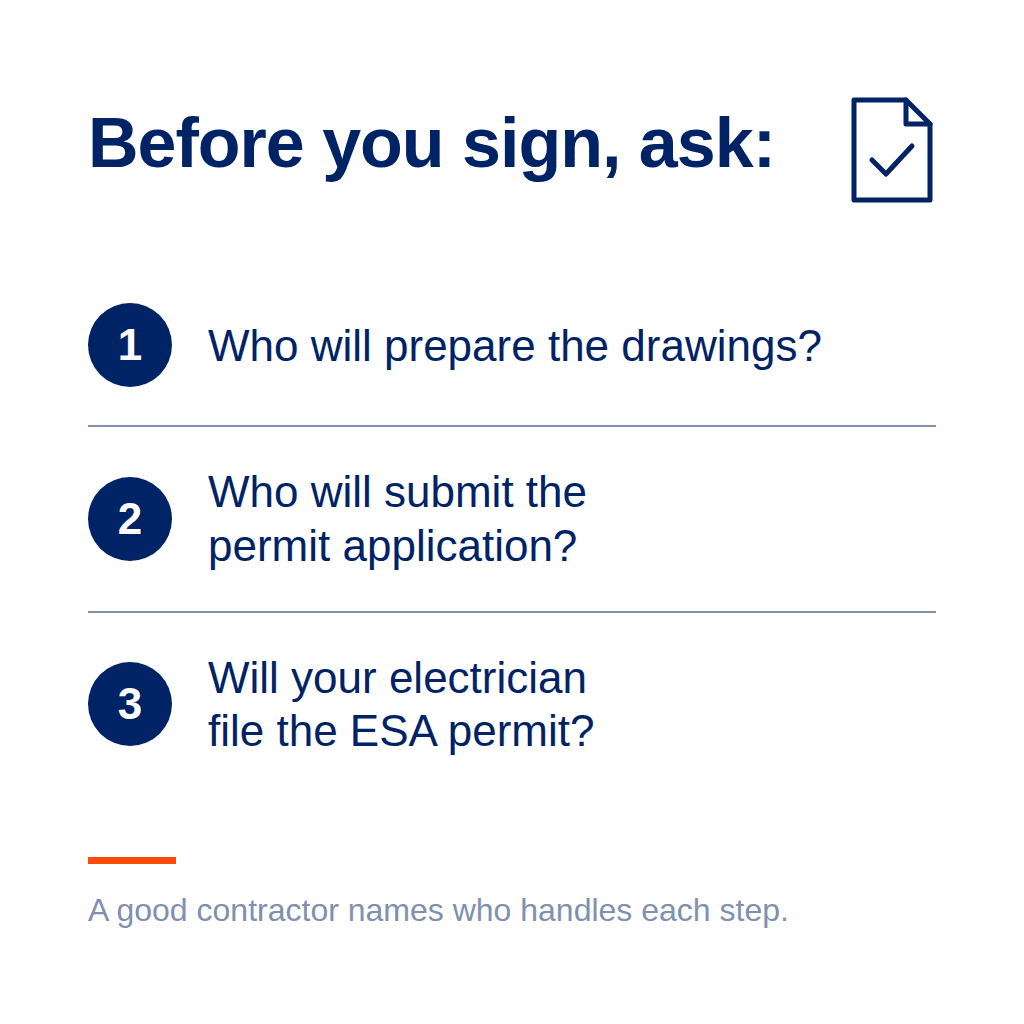
Before you sign, ask each contractor who will prepare the drawings, who will submit the application and whether their electrician will file the ESA permit. A good contractor answers right away and names who handles each step. If a contractor can’t say who is responsible for the permit, that’s a reason to keep looking.
On our jobs, a licensed engineer prepares the drawings and submits the permit application. You pay the engineer directly, so you can see exactly what the drawings cost, separate from our quote. For how the application works step by step, read our guide to getting a permit to finish a basement in Ontario.
What to check before you hire a basement contractor in Oakville
I’d run these checks on every contractor before signing, because each one is quick and each one protects you from a different problem. Most take one document or one search on a public website.
| What to check | How to check it | Why it matters |
|---|---|---|
| Building permit | Before you sign, ask who will prepare the drawings and apply for the permit. Once the Town of Oakville issues the permit, ask to see it before any work starts. | An issued permit means the Town has reviewed and approved the drawings your basement will be built from. |
| Liability insurance | Ask for a certificate of insurance in the company’s name, and check that the coverage dates include your job. | The contractor’s liability insurance covers damage the company or its crew causes to your home during the job. |
| Electrician’s licence | Get the electrical contractor’s licence number and look it up in the ESA contractor locator. | Only a Licensed Electrical Contractor can legally do electrical work in an Ontario home, whether you hire the electrician yourself or your general contractor does. There are some exemptions, so if a contractor says one applies to your job, check with the ESA before you agree. |
| Gas contractor registration | If the job includes a gas fireplace or a new gas line, look up the company in TSSA’s registry of fuels contractors. | Only a TSSA-registered fuels contractor can legally do gas work in Ontario. |
| Plumber’s certificate | If the job includes plumbing, look up the plumber’s name on the Skilled Trades Ontario public register. | Plumbing is a compulsory trade in Ontario, so the person doing the plumbing must hold a certificate or be a registered apprentice. |
| References | Ask for a few recent clients you can call. | Past clients can tell you whether the job finished the way the contractor promised and whether they would hire the contractor again. |
| Written workmanship warranty | Ask what the warranty covers and how long it lasts, and check that it’s written into the contract. | If the work fails after the job is done, the written warranty is your proof of what the contractor agreed to fix. |
Our guide on how to choose a basement renovation contractor in Ontario covers more of the hiring process, such as which trades and contractors Ontario licenses and how to protect yourself if your contractor doesn’t pay the sub-trades.
How to compare basement renovation quotes
Get written, itemized quotes from at least three contractors, and compare them line by line. Two quotes with similar totals can include very different work and materials. Comparing each part of the job shows you what each contractor would actually build for the price.
What an itemized quote lists
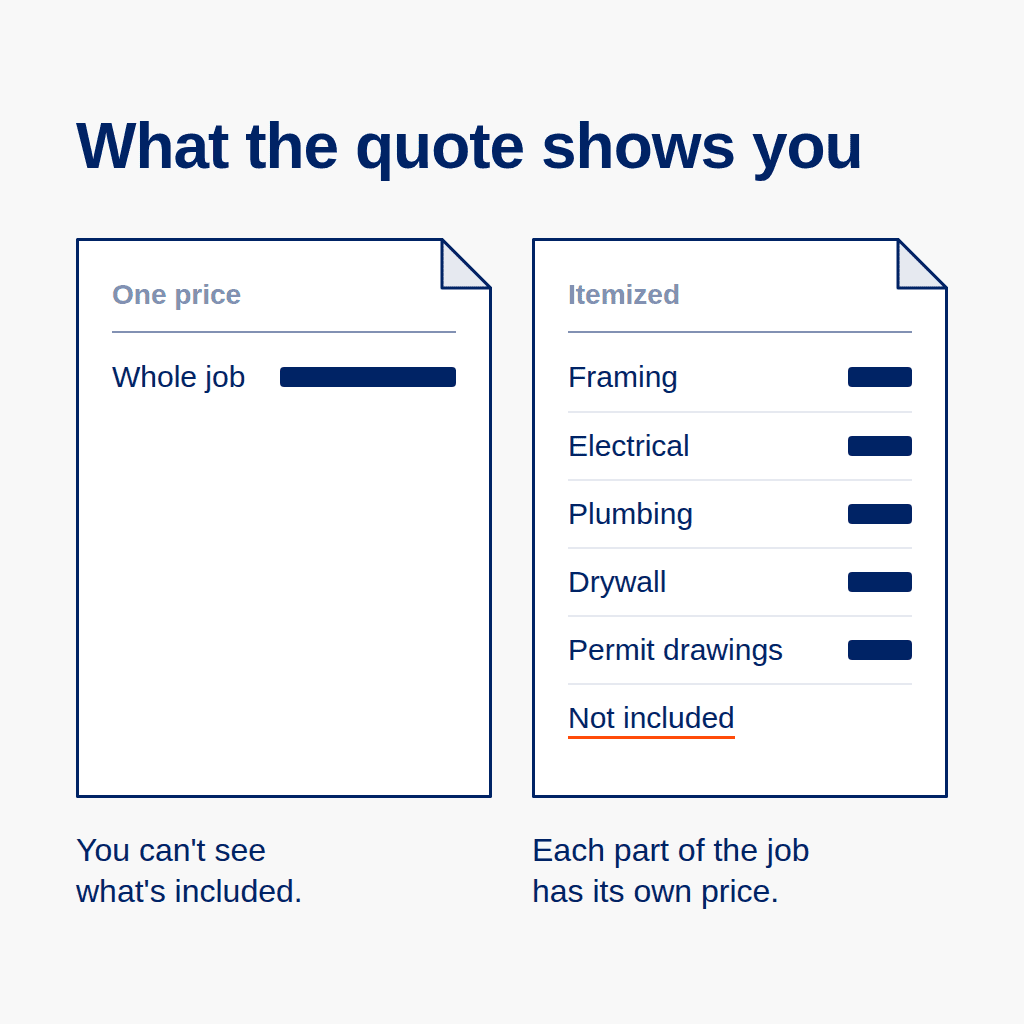
An itemized quote breaks the job into parts and gives each part its own price. Every quote we write at Bedrock is itemized, because that’s the easiest way for you to see what you’re paying for and to compare it with other quotes. The quote should list:
- Each part of the job on its own line, such as framing, electrical, plumbing and drywall
- The price of each line
- The materials and products for each line
- The permit drawings and who pays for them
- Anything the quote doesn’t include, so you know what you would pay for separately
When one quote is much lower than the others, look for the work it leaves out or the cheaper material it uses.
I’d be most careful with a low quote that gives one price for the whole job. Because it has no separate lines, you can’t see what the price includes. Any work it leaves out can be added later as an extra charge once the job has started.
For a sense of what basement finishing costs before your estimates, read our guide on how much it costs to finish a basement.
What goes in the contract
The contract is your record of what the contractor agreed to do, so everything you agreed on belongs in it. In Ontario, a home renovation contract has to be in writing if it’s worth more than $50. The province also recommends making sure your contract includes:
- The contractor’s name, address and contact information
- A description of the work and the materials
- A description of any warranties
- The total cost and the payment terms
- The payment schedule, including the deposit
- The start and completion dates
- Who is responsible for cleanup
- The sub-trades working on the job and who pays them. With their names, you can look up the licences of the trades doing your electrical, gas and plumbing work. Knowing who pays them tells you whether you should ever expect a bill from a sub-trade.
I’d also ask for the itemized quote to be part of the contract. That way, every line you compared between quotes is something the contractor has agreed to build.
If you sign the contract in your own home, you have a 10-day cooling-off period to cancel it for any reason without paying a cancellation fee. If the work started during those 10 days, you can still cancel, but you’ll be responsible for reasonable compensation for work and materials the contractor has provided.
Deposits and payments
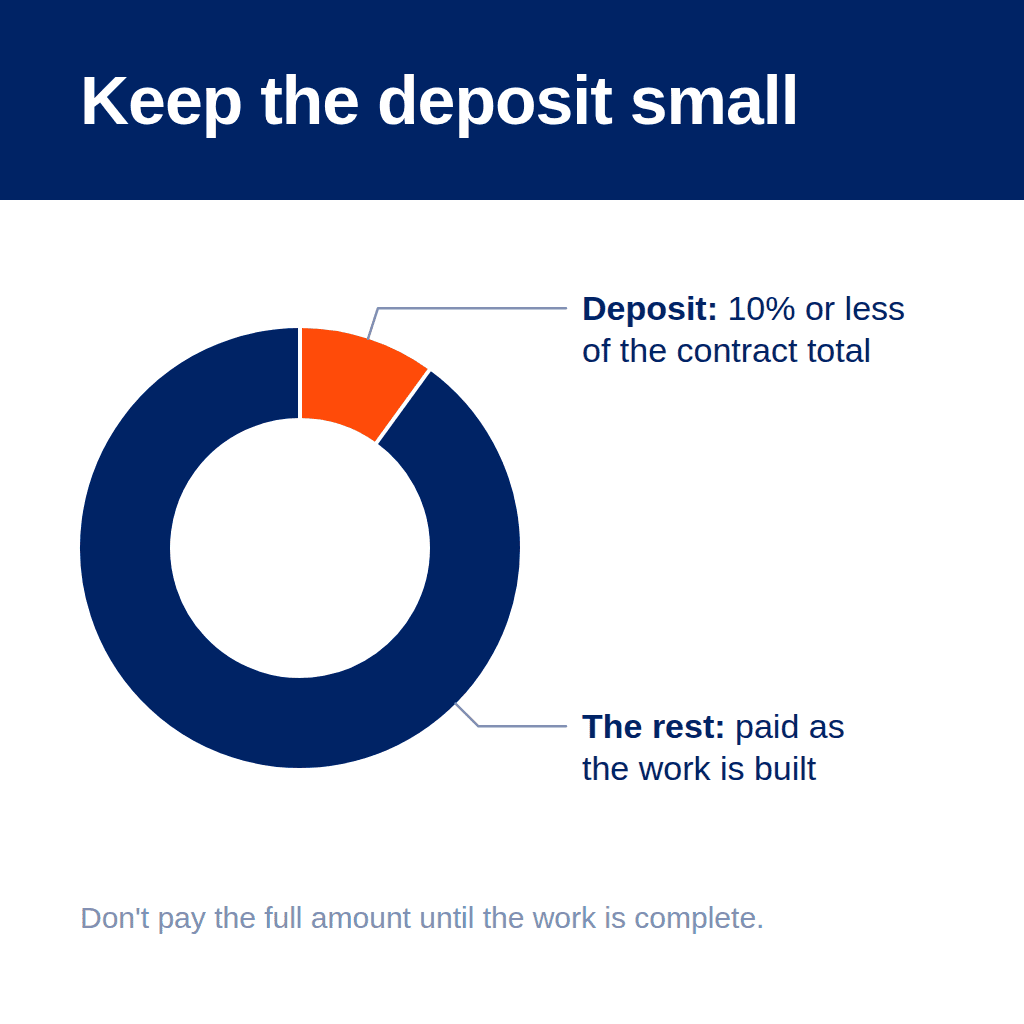
Keep the deposit to 10% of the contract total or less. You pay the deposit before any work is done, so if the contractor never starts the job, that money could be gone. A small deposit means less of your money is at risk before the work begins. Don’t pay the full amount until the work is complete. A payment schedule that follows the progress of the work means you never pay for much more than has been built.
Holding the final payment until the job is finished also gives the contractor a reason to fix anything you’re not happy with before they leave. That’s how we handle payment on our own jobs: the final payment is due only after the basement is complete and we’ve done the final walkthrough together.
Questions to ask a basement contractor before you hire
Ask these questions at each on-site estimate, while you’re standing in the basement with the contractor. Listen for answers that are specific and honest. Vague answers and big promises are the ones to worry about.
| Question | A good answer | A worrying answer |
|---|---|---|
| Who will be in my house each day, and who do I call with a question? | They name who will be on site and one person you can call with any question. | They can’t say who will be on site, or there’s no single person to call. |
| What’s the schedule from start to finish? | They give you a start date and a completion date. | They won’t commit to any dates. |
| How do you price a change if I add something partway through? | They give you a written price for the change, and you approve it before they do the work. | They say they’ll add it all up at the end of the job. |
| What happens if you open a wall and find a problem behind it? | They show you the problem, explain your options and give you a written price before doing any extra work. | They say it won’t happen, or that they’ll fix it and add it to the bill. |
| Will I see a design before construction starts? | They’ll show you a layout of the finished basement, such as a floor plan or a 3D design, and you can make changes to it before the permit drawings are prepared. | They plan to decide the layout as they build. |
| How will you protect the rest of my house, and who cleans up? | They explain how they’ll keep dust out of the rest of the house and who cleans up at the end of each day. | They have no plan for dust, or cleanup waits until the end of the job. |
| Can my family stay in the house while you work? | They tell you plainly whether you can stay, and which parts of the job will be noisy or dusty. | They promise you won’t even notice they’re there. |
Write down each contractor’s answers so you can compare them when you choose.
Red flags when hiring a basement contractor
Some warning signs show up in how a contractor behaves at the estimate, even when their documents are in order. Any one of these is a reason to keep looking.
- They say your basement doesn’t need a permit. A contractor who tells you that either doesn’t know Oakville’s rules or is willing to break them.
- They push you to sign the same day. A price that’s only good today leaves you no time to compare it with your other quotes or to check the contractor’s details.
- They want the deposit in cash. A cash payment leaves you with no record of what you paid if you and the contractor disagree later.
How to choose between contractors who pass every check
When two or three contractors pass every check, choose the one who is most honest with you, explains things most clearly and will stay with your job from the estimate to the final walkthrough.
Honesty is what I’d weigh most, because a contractor who tells you what could go wrong on your job before you sign is showing you how they’ll talk to you once the job starts.
What a contractor should warn you about depends on whether your basement is finished now. An unfinished basement is fairly predictable, because nothing is covered up and the contractor can see what they’re working with. An old finished basement is different. Tearing out the old finish can uncover problems that weren’t visible at the estimate, such as old wiring or plumbing that needs to be replaced. If your basement has an old finish, the contractor who warns you about hidden problems without being asked is being honest about what your job may involve.
Honesty also shows in the promises a contractor makes. Nearly every contractor describes their work as the best, the cleanest or the fastest. Words like those don’t commit the contractor to anything. A completion date, a warranty and a price are different, because once they’re written into the contract, the contractor has agreed to them.
Choose the contractor whose explanations you understood. You’ll be making decisions with that person throughout the job, so you need to be able to follow their reasoning.
Think about who you’ll deal with after you sign, too. The person who came to your house and heard what you want already knows your job. When that same person designs it and runs it through to the end, nothing you said at the estimate has to be passed along to someone new. At each estimate, ask whether the person you’re talking to will also be the one running your job.
Planning a basement apartment in Oakville?
Oakville allows basement apartments, and you need a building permit to build one. A legal suite has to meet more code requirements than a basement you finish for your own family, so ask each contractor whether they have built legal basement suites to code before. Our guide to basement apartment legal requirements in Ontario explains what a legal suite needs, and you can also see how we build basement suites.
Getting a quote for your Oakville basement
If you’d like Bedrock to be one of the contractors you compare, start with our Oakville basement renovations page. You can also see each step of how we work before we meet.
When you’re ready, book a free on-site consultation. I’ll look at your basement, answer your questions and give you a rough price during the visit. After that, I’ll email you a detailed, itemized quote.